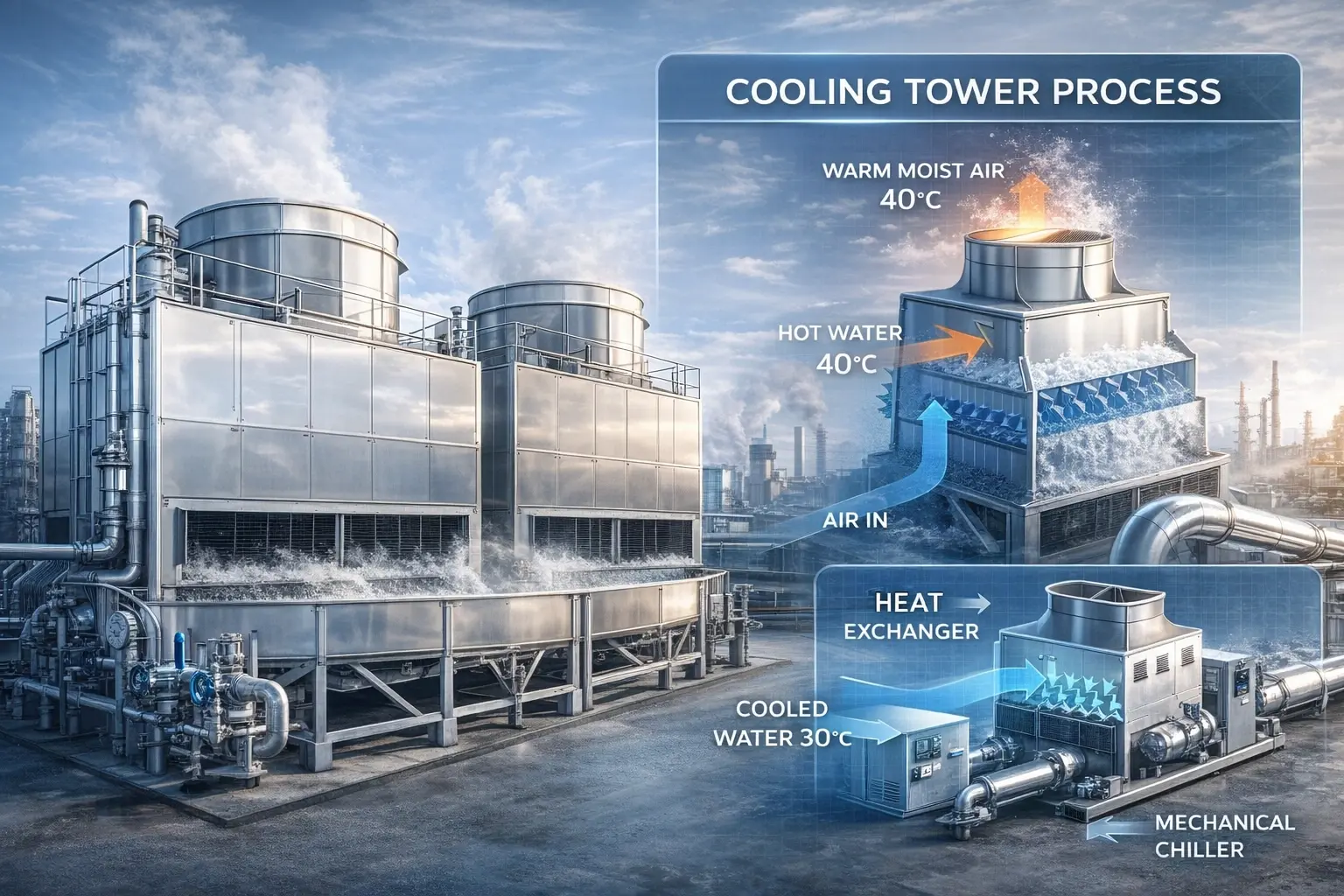
Cooling towers are among the most critical components in industrial plants and large-scale commercial facilities, playing a key role in maintaining process continuity and operational efficiency. During industrial operations, a significant amount of excess heat is generated, and if this heat is not effectively removed, it can negatively impact equipment performance, system reliability, and overall production efficiency. Cooling towers provide a reliable and energy-efficient solution for dissipating this excess heat to the atmosphere.
The primary function of a cooling tower is to reduce the temperature of warm water discharged from chillers, heat exchangers, compressors, or industrial processes by bringing it into contact with ambient air. This heat rejection process is based on the principle of evaporative cooling. A small portion of the circulating water evaporates, absorbing latent heat and thereby lowering the temperature of the remaining water, which is then recirculated back into the system.
Cooling towers are widely used across various industries, including power generation, petrochemical plants, steel production, food and beverage processing, plastic injection molding, HVAC systems, and data centers. In continuous and high-load operations, the performance of the cooling tower directly affects production capacity, energy consumption, and operational costs. A properly designed cooling tower ensures stable operating conditions and protects critical equipment from overheating.
Cooling towers are generally classified into two main categories based on their operating principle: open-circuit (wet) cooling towers and closed-circuit cooling towers. In open-circuit systems, process water comes into direct contact with air, allowing efficient heat transfer and high cooling capacity. Closed-circuit cooling towers, on the other hand, use a coil or heat exchanger in which the process fluid circulates without direct contact with air, making them ideal for applications where water quality and process fluid cleanliness are critical.
Several technical parameters must be considered in the design and selection of a cooling tower. These include ambient temperature, wet-bulb temperature, heat load, water flow rate, fan type, fill media, and tower structure. Among these, the fill media plays a crucial role by increasing the contact surface area between water and air, thereby enhancing heat transfer efficiency. High-quality fill designs enable higher thermal performance with lower energy consumption.
Energy efficiency has become one of the most important criteria in modern cooling tower selection. Fan motors, airflow design, and water distribution systems significantly influence total power consumption. Advanced cooling towers are equipped with high-efficiency fans, variable frequency drives (VFDs), and optimized air paths to deliver maximum cooling performance with minimal energy usage. These features help reduce operating costs and contribute to sustainable plant operations.
Water consumption and water quality management are also critical aspects of cooling tower operation. Evaporation, drift, and blowdown losses must be carefully controlled to prevent excessive water usage. Drift eliminators minimize water droplets carried away by airflow, while automated water level and blowdown control systems help maintain optimal water chemistry. Proper chemical treatment prevents scale formation, corrosion, and biological growth, ensuring long-term system reliability.
Maintenance is a vital factor in the long-term performance and safety of cooling towers. Regular inspection, cleaning of fill media, fan and motor maintenance, and continuous monitoring of water quality are essential to maintain cooling efficiency and prevent unexpected downtime. Poorly maintained cooling towers can suffer from reduced heat transfer capacity, increased energy consumption, and premature equipment failure.
In conclusion, cooling towers are not merely auxiliary components but strategic systems at the heart of industrial thermal management. Proper capacity selection, suitable tower type, high-quality materials, and professional engineering design are essential to achieving optimal performance. A well-designed and efficiently operated cooling tower system provides lower operating costs, enhanced system reliability, and long-term investment value. In today’s competitive industrial environment, efficient cooling tower solutions are fundamental to sustainable, high-performance operations.