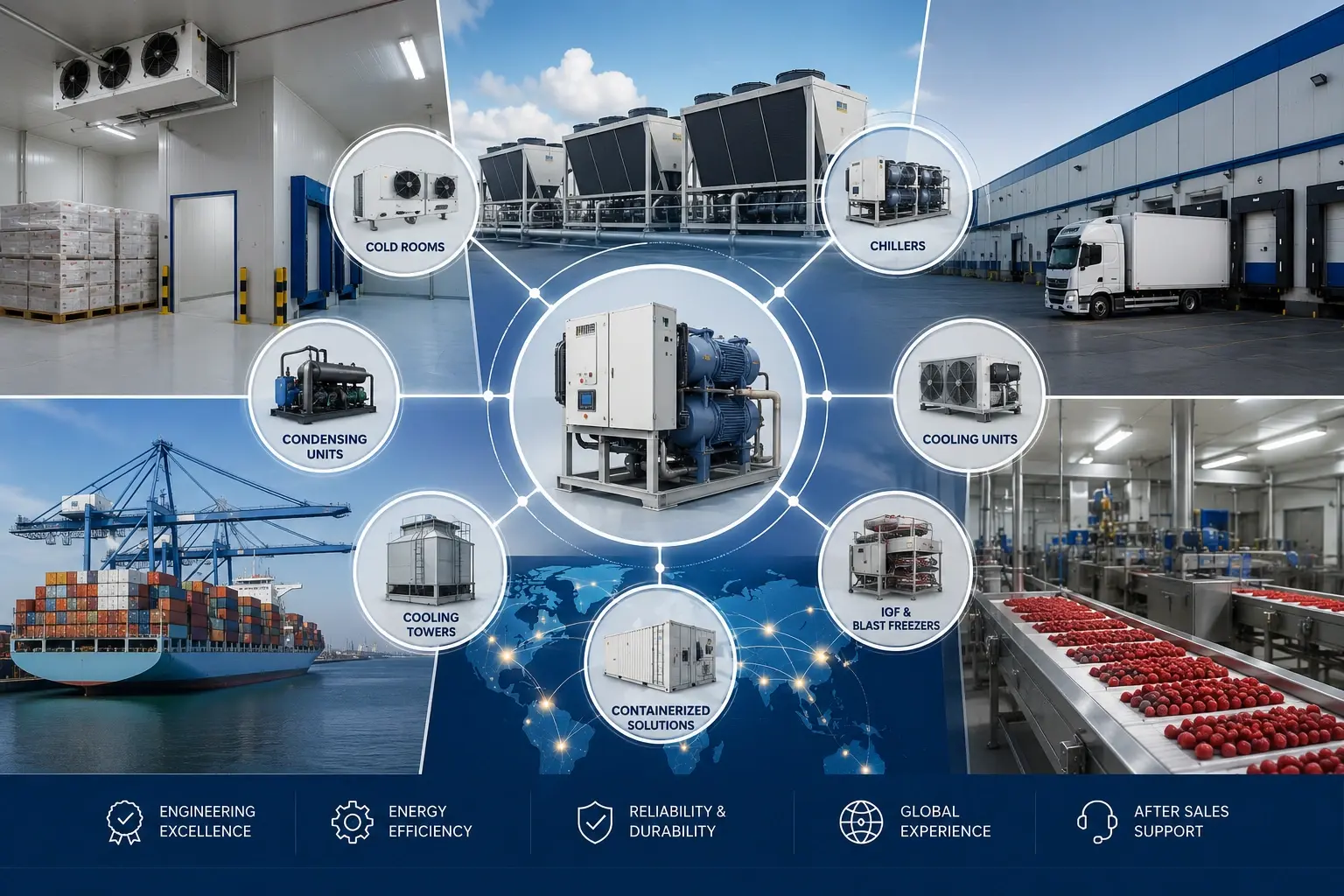
40 Frequently Asked Questions About Industrial Cooling Systems
Industrial refrigeration systems are the backbone of food processing, cold chain logistics, pharmaceuticals, manufacturing, and many other industries. Whether you are planning a new project or upgrading an existing facility, the following frequently asked questions will help you better understand industrial cooling technologies and choose the right solution.
General Questions
1. What is an industrial refrigeration system?
An industrial refrigeration system removes heat from products, production processes, or enclosed spaces to maintain controlled temperatures for storage or manufacturing.
2. Which industries use industrial refrigeration?
Food processing, seafood, dairy, pharmaceuticals, logistics, agriculture, beverage production, chemical plants, concrete cooling, and many manufacturing industries.
3. Why is industrial refrigeration important?
It preserves product quality, extends shelf life, supports food safety, protects sensitive materials, and improves production efficiency.
4. What are the main components of a refrigeration system?
Compressors, condensers, evaporators, expansion valves, refrigerants, control systems, and piping.
Cold Rooms
5. What is a cold room?
A temperature-controlled storage facility designed to preserve products under specific environmental conditions.
6. What temperature ranges are commonly used?
Fresh storage (+2°C to +8°C), chilled storage (0°C to +4°C), frozen storage (-18°C), and deep-freeze applications (-25°C to -40°C).
7. How do I determine the correct cold room size?
Capacity depends on storage volume, daily product turnover, product type, and future expansion plans.
8. Which products require cold rooms?
Fresh produce, meat, seafood, dairy products, pharmaceuticals, flowers, beverages, and frozen foods.
9. How long does a cold room last?
With proper maintenance, a professionally designed cold room can operate efficiently for more than 20 years.
Cooling Units
10. What is a cooling unit?
A cooling unit directly cools enclosed spaces using air circulation and refrigeration components.
11. Where are cooling units commonly used?
Cold rooms, food storage facilities, supermarkets, logistics warehouses, and production rooms.
12. How energy efficient are modern cooling units?
High-efficiency compressors, EC fans, and smart controllers significantly reduce operating costs.
Chillers
13. What is a chiller?
A chiller cools water or another heat transfer fluid, which is circulated to cool equipment or industrial processes.
14. Where are chillers used?
Industrial production, concrete cooling, HVAC systems, food processing, plastics, and chemical manufacturing.
15. Air-cooled or water-cooled chiller?
Air-cooled chillers are easier to install, while water-cooled chillers typically provide higher efficiency in large-scale applications.
16. How is chiller capacity determined?
Capacity depends on heat load calculations, process requirements, ambient conditions, and operating hours.
Cooling Towers
17. What is a cooling tower?
A cooling tower removes unwanted heat from circulating water through evaporative cooling.
18. Why combine chillers with cooling towers?
Cooling towers improve system efficiency and reduce operating costs in water-cooled installations.
19. How often should cooling towers be maintained?
Regular inspection, cleaning, and water treatment are recommended every few months depending on operating conditions.
IQF & Blast Freezing
20. What is IQF freezing?
IQF (Individual Quick Freezing) freezes products individually, preventing them from sticking together.
21. Which industries use IQF?
Frozen vegetables, fruits, seafood, poultry, bakery products, and ready meals.
22. What is a blast freezer?
A blast freezer rapidly reduces product temperature to preserve freshness and product quality.
23. IQF or Blast Freezer?
IQF is ideal for individually frozen products, while blast freezers are suitable for bulk freezing.
Refrigeration Technology
24. Which refrigerant is best?
The optimal refrigerant depends on efficiency requirements, environmental regulations, safety standards, and application type.
25. How can energy consumption be reduced?
Proper system design, inverter technology, EC fans, insulation, automation, and preventive maintenance all improve efficiency.
26. How often should refrigeration systems be serviced?
Professional maintenance is recommended every 3–6 months.
27. What causes refrigeration system failures?
Poor maintenance, refrigerant leaks, dirty condensers, electrical faults, incorrect sizing, and inadequate airflow.
28. How long do compressors last?
Typically 10–20 years, depending on operating conditions and maintenance.
Project Planning
29. What information is needed before starting a project?
Product type, required temperature, storage volume, ambient conditions, operating schedule, and installation location.
30. Why are heat load calculations important?
Accurate calculations ensure correct equipment sizing, lower energy consumption, and reliable system performance.
31. Can refrigeration systems be expanded later?
Most modern industrial systems can be designed for future expansion.
32. What is a turnkey refrigeration project?
A complete solution covering engineering, manufacturing, installation, commissioning, training, and after-sales support.
Investment & Sustainability
33. How do I choose the right refrigeration supplier?
Look for engineering expertise, manufacturing quality, project references, technical support, and global service capabilities.
34. Which regions are investing most in cold chain infrastructure?
The Middle East, Africa, Southeast Asia, and Central Asia are among the fastest-growing markets.
35. What are the biggest trends in industrial refrigeration?
Energy efficiency, natural refrigerants, smart automation, remote monitoring, and sustainable cooling technologies.
36. How can automation improve refrigeration systems?
Automation optimizes energy consumption, improves reliability, and enables predictive maintenance.
37. Is remote monitoring important?
Yes. It allows operators to monitor temperatures, alarms, and system performance in real time.
38. What affects operating costs the most?
Energy consumption, maintenance quality, equipment efficiency, and system design.
39. Why is preventive maintenance essential?
Regular maintenance minimizes unexpected downtime, extends equipment life, and reduces repair costs.
40. Why choose an experienced engineering company?
Professional engineering ensures reliable system performance, optimized energy consumption, long equipment life, and successful project execution.
Industrial refrigeration is much more than simply producing cold temperatures. It is a strategic investment that affects product quality, operational continuity, energy efficiency, and long-term profitability.
By understanding these frequently asked questions, businesses can make informed decisions and select refrigeration solutions that best match their operational needs while maximizing return on investment.