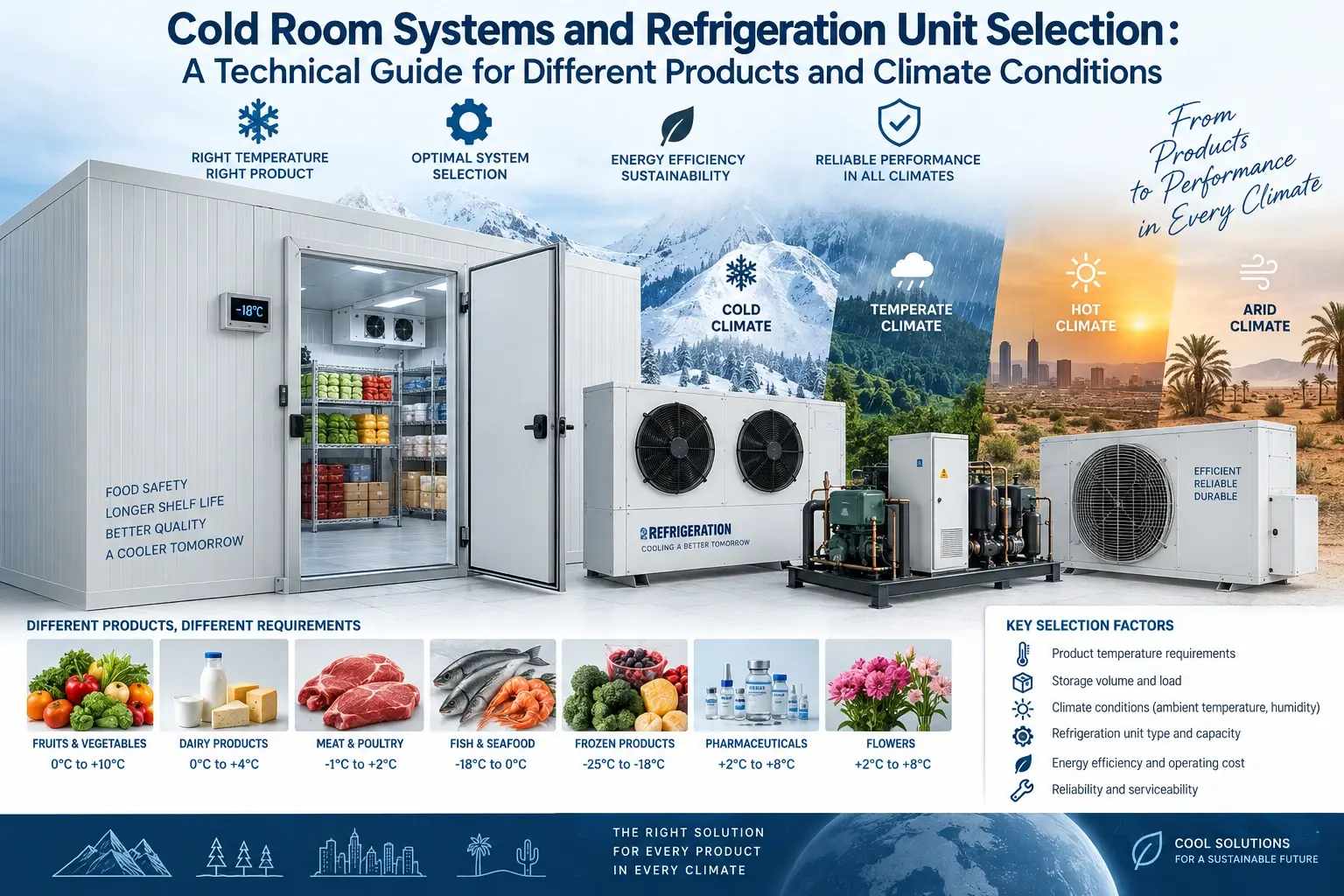
A Technical Guide for Different Products and Climate Conditions
A cold room storing beef, poultry, fish, dairy products, eggs, fruit, vegetables or ice may require completely different refrigeration conditions even when the rooms have the same dimensions. Likewise, a system designed for Northern Europe may perform very differently if the same equipment is installed in Saudi Arabia, West Africa, Florida or another hot and humid region.
Correct cold room design therefore requires the refrigeration unit, evaporator, condenser, compressor, insulation panels, controls and—in certain applications—humidification system to be evaluated as one integrated system.
Colderman develops Cold Room Systems and Industrial Cooling Units for different products, operating temperatures and climatic conditions.
Different Food Products Require Different Cold Room Conditions
Temperature alone does not determine the quality of cold storage. Relative humidity, air velocity, evaporator temperature difference, product loading and storage duration can be equally important. Typical design ranges may include:
|
Product / Application |
Typical Room Temperature |
Typical RH |
Key Design Consideration |
|
Fresh red meat |
0 to +2°C |
85–90% |
Limit dehydration and weight loss |
|
Fresh poultry |
0 to +2°C |
85–90% |
Rapid cooling, hygiene and stable temperature |
|
Fresh fish |
-1 to +2°C |
90–95% |
High humidity and minimum temperature fluctuation |
|
Frozen meat |
-18 to -22°C |
Application dependent |
Insulation and reliable low-temperature capacity |
|
Frozen fish |
-18 to -25°C |
Application dependent |
Stable low-temperature operation |
|
Dairy products |
+2 to +6°C |
Product dependent |
Precise temperature control |
|
Eggs |
Approx. +4 to +8°C |
70–85% |
Stable temperature and controlled humidity |
|
Fruit & vegetables |
Approx. 0 to +12°C |
85–95% |
Product-specific temperature and high humidity |
|
Frozen packaged food |
-18 to -22°C |
Application dependent |
Continuous low-temperature operation |
|
Ice storage |
Approx. -5 to -10°C |
Application dependent |
Minimize melting and agglomeration |
These values are general engineering ranges rather than final project setpoints. Exact conditions should be determined according to the specific product, packaging, storage period, loading pattern and applicable food-safety requirements.
Cold Rooms for Beef and Red Meat
In fresh meat storage, the objective is not only to reduce temperature but also to protect product weight, color and surface quality. Excessive air velocity or an unnecessarily large temperature difference across the evaporator can increase moisture loss from the product.
Even a small percentage of additional dehydration can become a significant commercial loss. For example, an additional 1% weight loss from 10 tonnes of stored meat represents approximately 100 kg of product.
For this reason, evaporator surface area, evaporating temperature, air distribution and room relative humidity should be evaluated together. Where required, controlled humidification can be incorporated to help maintain suitable storage conditions.
Poultry and Chicken Cold Storage
Poultry applications require strict temperature control, hygiene and, in many cases, rapid removal of product heat. If warm product enters the room directly from processing, a cold room designed only for storage may not have enough capacity to pull the product temperature down within the required time.
In such cases, precooling, blast chilling or blast freezing should be considered separately from normal storage. Colderman blast freezing solutions can be integrated into food processing facilities where rapid temperature reduction is required.
Explore Colderman Blast Freezer solutions
Fish and Seafood Cold Rooms
Fish and seafood are among the most temperature-sensitive food products. Fresh fish is generally stored close to 0°C, while high relative humidity helps limit surface dehydration and weight loss.
In seafood facilities, cold storage is often only one part of the complete cold-chain process. A project may combine ice production, precooling, chilled storage, rapid freezing and frozen storage. For products intended for long-term storage or export, rapid freezing can become essential for preserving texture and product quality.
Related systems: Blast Freezer and IQF / Spiral Freezing Systems
Dairy Products and Eggs
Milk, cheese, butter, yogurt and other dairy products can require different storage temperatures and humidity conditions. Large facilities may therefore benefit from separate temperature zones rather than one central cold room for every product.
Egg storage also requires stable temperature and appropriate humidity. In both applications, good air distribution is important: excessive airflow can affect product quality, while poor circulation can create temperature differences inside the room.
Fruit and Vegetable Cold Storage
Fresh produce requires particularly careful refrigeration design because optimal conditions vary significantly by crop. Some products can be stored close to 0°C, while tropical or chilling-sensitive produce can be damaged at temperatures that are perfectly suitable for other fruits or vegetables.
High relative humidity is often important to reduce water loss. Large-surface evaporators, controlled air velocity, suitable coil temperature differences and humidification systems may therefore be used depending on the product.
Ice Storage Rooms
An ice storage room should not automatically be designed like a conventional frozen-food warehouse. The product is already frozen; the objective is primarily to minimize melting, surface deterioration and blocks or pieces sticking together.
Depending on ice type, storage duration and handling method, temperatures around -5°C to -10°C may be sufficient for many applications. Daily ice input, ice entering temperature, door traffic and storage time must still be included in the refrigeration load calculation.
Cold Room Panel Thickness and Thermal Insulation
Correct refrigeration equipment cannot compensate for poor insulation. Panel thickness should be selected according to room temperature, ambient temperature, solar exposure, floor construction and operating conditions.
|
Application |
Typical PU Panel Thickness |
|
+2 to +8°C chilled storage |
80–100 mm |
|
Around 0°C |
Approx. 100 mm |
|
-18 to -22°C frozen storage |
120–150 mm |
|
-25°C and below |
150–200 mm |
|
Very hot climate + low room temperature |
Project-specific; increased insulation may be justified |
These are typical ranges. Final insulation thickness must be determined by project-specific heat-transfer calculations and local conditions.
Why Climate Changes Refrigeration Unit Selection
The same cold room can require different equipment depending on where it is installed. Ambient design temperature directly affects condenser performance, compressor operating conditions and the total refrigeration capacity available at the evaporator.
Africa and the Middle East: Designing for High Ambient Temperatures
In countries such as Saudi Arabia, the UAE, Qatar, Kuwait, Oman, Senegal, Ghana, Nigeria, Mali and Chad, refrigeration equipment may face ambient temperatures above 40°C, and in some locations design conditions can approach 45–50°C.
A condenser selected only for moderate European conditions can become undersized in these environments. Condensing pressure may rise, compressor power consumption can increase, refrigeration capacity can fall and high-pressure trips may occur. Larger condenser surfaces, appropriate fan capacity, correct compressor selection and sufficient design margin are therefore essential.
Colderman Industrial Cooling Units
Europe: Do Not Design Only for Average Weather
Northern and Western European countries may have lower annual average temperatures, but refrigeration equipment should still be capable of operating safely during summer peaks. A system that spends much of the year at moderate ambient temperature may still need to operate during periods above 30–35°C. Maximum expected design conditions—not annual averages—should therefore influence condenser and compressor selection.
The Americas: One Continent, Many Refrigeration Climates
Cold storage conditions in Canada or the northern United States are very different from Florida, Texas, Mexico, the Caribbean or tropical parts of South America. Hot and humid climates introduce an additional challenge: every door opening can bring a large quantity of warm, moisture-laden air into the cold room.
This infiltration increases refrigeration load and can accelerate frost formation on evaporators. Fast-closing doors, PVC strip curtains, air curtains, vestibules and correctly designed defrost systems can substantially improve operation in high-traffic facilities.
How Should Cold Room Refrigeration Capacity Be Calculated?
A professional cold-room load calculation should include all significant sources of heat. A simplified representation is:
Qtotal = Qtransmission + Qproduct + Qinfiltration + Qinternal + Qequipment
Qtransmission: Heat transferred through walls, ceiling, floor and other building surfaces.
Qproduct: Heat that must be removed from incoming products, including sensible and—when freezing—latent heat.
Qinfiltration: Heat and moisture entering when doors open or through air leakage.
Qinternal: People, lighting and other internal heat sources.
Qequipment: Evaporator fans, motors and other equipment operating inside the room.
Product load is frequently underestimated. Ten tonnes of product entering a room at +25°C creates a completely different load from ten tonnes entering at +2°C. This is why the question “How many HP do I need for a 100 m³ cold room?” cannot be answered accurately without knowing the product and operating conditions.
Compressor, Condenser and Evaporator Must Be Selected as One System
Refrigeration capacity is not determined by compressor horsepower alone. Compressor, condenser, evaporator, expansion device, refrigerant circuit and controls must operate as a matched system.
A powerful compressor connected to an undersized condenser in a hot climate may never deliver its expected capacity. Similarly, an incorrectly selected evaporator can lead to excessive product dehydration, unstable room temperature, high frost accumulation or inefficient operation.
Seasonal Temperature Changes Must Be Part of the Design
A professional cold room should be engineered for the range of conditions it will experience throughout the year. A facility may operate with +5°C ambient air in winter and +40°C in summer. The system must deliver sufficient capacity during peak conditions while still operating efficiently at partial load during cooler periods.
Capacity control, fan-speed control, suitable compressor technologies and intelligent control strategies can help adapt system output to real demand and reduce unnecessary energy consumption.
The Right Cold Room Is an Engineering Project, Not Just a Refrigeration Unit
When comparing industrial cold storage systems, purchase price and compressor horsepower should never be the only criteria. The correct solution is based on the combination of product, capacity, temperature, humidity, climate, insulation and operating conditions.
A room designed for beef is not automatically ideal for fish. A system engineered for Germany should not simply be copied for Saudi Arabia. A +4°C chilled room refrigeration unit cannot be treated as equivalent to a -20°C frozen-storage system.
An undersized or incorrectly designed system may appear less expensive at the investment stage, but higher energy consumption, product losses, insufficient capacity and premature compressor failures can make it significantly more expensive over its operating life.
Colderman Industrial Refrigeration Solutions
Colderman develops project-specific industrial refrigeration systems for different food products, storage temperatures and climatic regions.